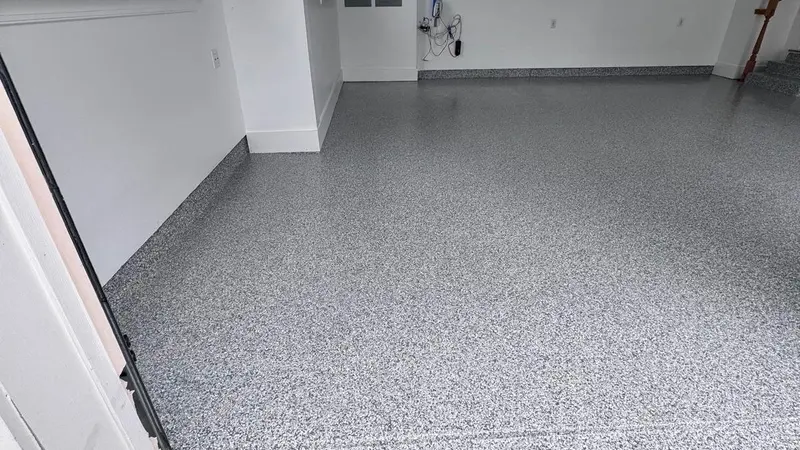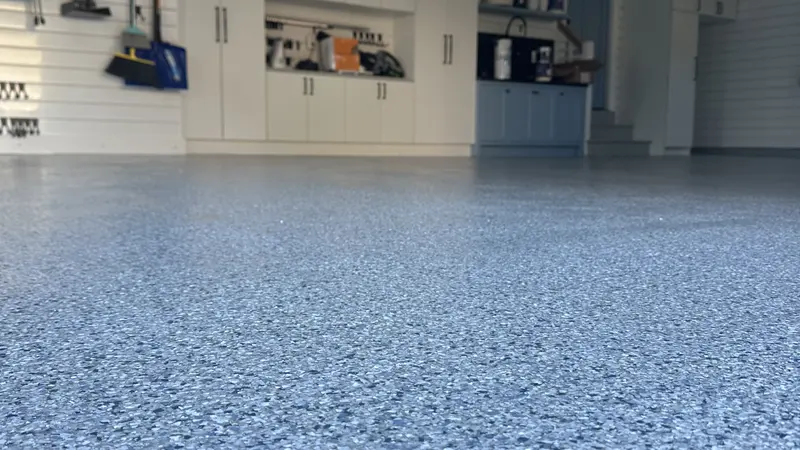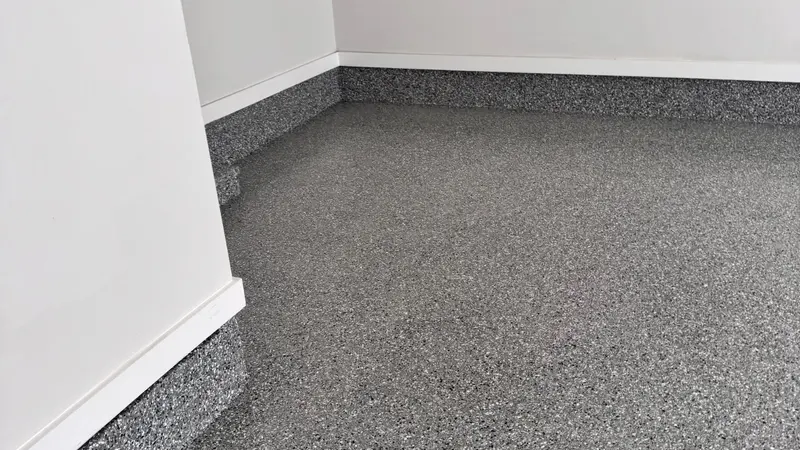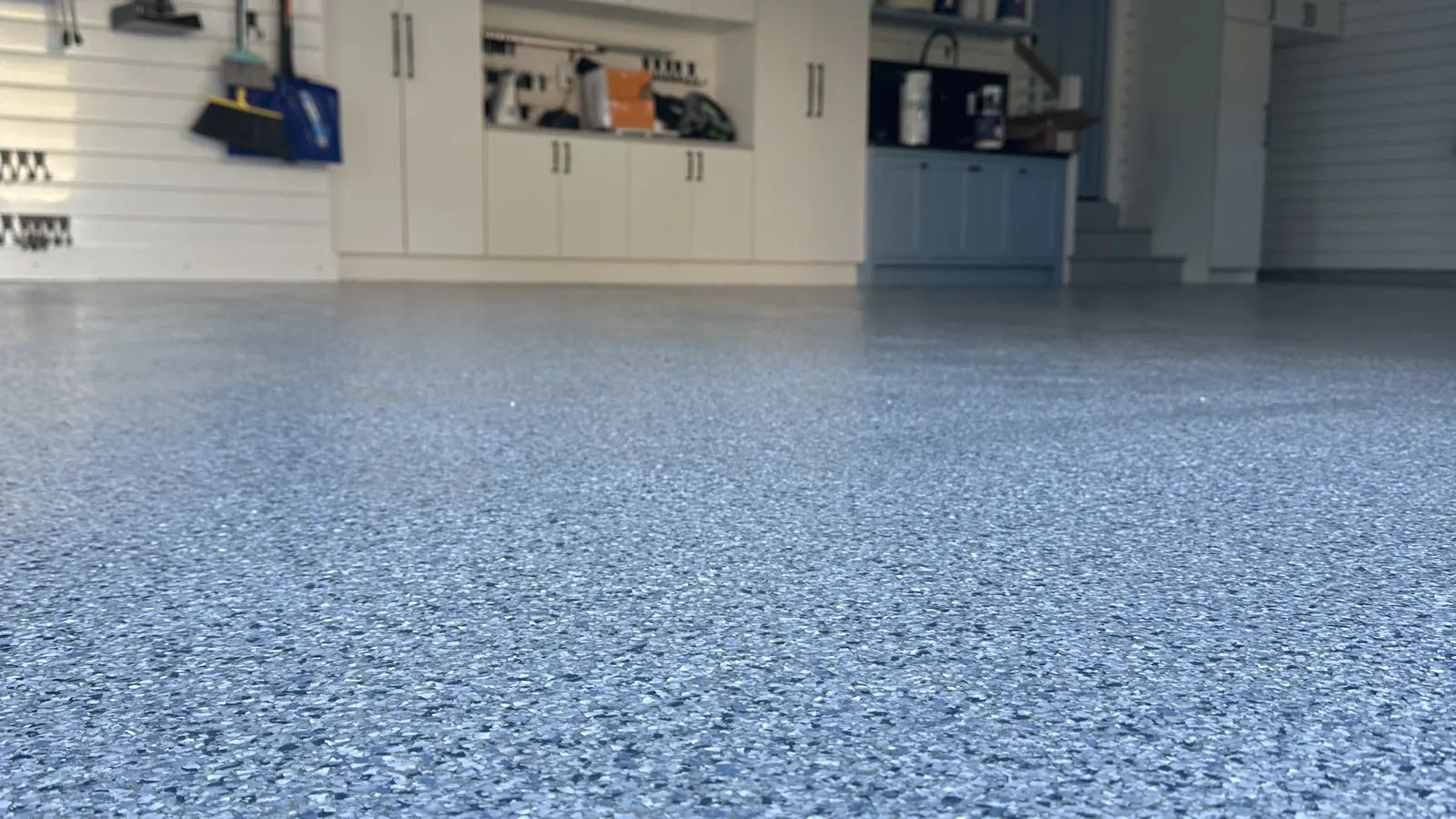
In a lot of McLean homes, the garage is the only room that never got touched. The kitchen has been redone, the basement is finished, the floors inside are new, and then you open the door from the mudroom and there is gray concrete with tire marks, a salt ring and a crack running toward the drain. A polyaspartic coating is what closes that gap: one day of work, a finish that matches the rest of the house, and a floor that holds up to cars, salt and summer humidity for 15 to 20 years or more.
We have been coating floors across Northern Virginia since 2014, and McLean sends us two very different kinds of concrete. Knowing which one you have changes what the job looks like.
Why is the garage always the last room?
Because it is the one room where nobody is sure what the finished version looks like. You can picture a new kitchen. A garage is harder. Most homeowners have only seen bare concrete, a flaking big-box kit, or a showroom photo that looks nothing like a real two-car garage with a lawn mower and four bikes in it.
The practical answer is that a coated floor reads as part of the house instead of a slab under it. Flake blends give you a speckled, stone-like surface with real texture. Light bounces off a clear topcoat, so a garage that always felt dim gets noticeably brighter with the same light fixtures. Dust stops, because bare concrete is porous and constantly sheds fine powder onto everything stored on it. That is the part people mention most after the fact.
What do McLean slabs actually look like under the dirt?
McLean splits cleanly. On one side you have the original mid-century colonials and ranches off Old Dominion Drive, around Chesterbrook and toward Chain Bridge Road, with slabs poured in the 1950s through the 1970s. That concrete is usually sound but tired: surface pitting where the top layer has spalled, oil shadows from forty years of cars, hairline cracks from the clay soil underneath moving through wet springs and dry Augusts, and sometimes an old paint or sealer that is peeling in sheets.
On the other side you have the newer custom builds that replaced those houses, plus the townhomes and condos closer to Tysons. Those slabs are clean and flat, which is the easy part. The thing to watch there is moisture. A newer slab can still be releasing water vapor, and clay soil holds water against the underside of a slab longer than sandy soil does. That matters because a coating that is put down over a slab pushing vapor is a coating that lets go later. We cover what we find on your specific slab at the estimate, and if you want the background first, we wrote about moisture in a concrete slab and what it means for a coating.
Neither condition is a dealbreaker. Pitting and cracks get ground open and repaired as part of the install, the same way we handle decades-old concrete in Fairfax. What we will not do is coat over a problem and hope.
How do you pick a color that matches the house?
Start with what the garage opens into. If you walk from the garage into a mudroom with slate or porcelain tile, a darker blend keeps the transition quiet. If the garage is detached or sits down a long driveway, you have more freedom to go lighter and brighter.
Three blends cover most of what we install in McLean:
- Creekbed is warm, with browns and tans. It sits well next to brick, stone and painted-wood colonials, and it is forgiving with the red-brown clay that rides in on tires after a rain.
- Tidal Wave is cooler, blues and grays. It fits newer builds with gray or white exteriors and modern interior finishes.
- Gravel is a neutral gray and black mix. It is the safest match for a house that has been renovated in grays and whites, and it is the one people pick when they want the floor to disappear and the cars to stand out.
Metallic, marbled, quartz and solid colors are all available too. Metallic tends to show up in garages that are doing double duty as a display space or a gym. If you are torn, read solid color versus flake, then look at the flake color options. We also bring physical samples to the estimate, because a chip on a screen and a chip in your actual garage light are different things.
Will it hold up to how we actually use the garage?
The product we install is polyaspartic, an industrial coating used in factories, rail cars and sports stadiums. It is not an epoxy kit. That matters in a McLean garage for a few specific reasons.
Road salt is the big one. Between the GW Parkway, Route 123 and the neighborhood streets that get treated before every forecast, your tires carry brine into the garage from December through March. On bare concrete that brine soaks into the pores, freezes, expands and pops the surface apart over a few winters. Polyaspartic does not absorb it, so salt and snowmelt sit on top and mop away.
Hot tires are the second. A car that has been sitting in summer traffic on the Beltway comes home with tires hot enough to soften weaker coatings and lift them off the slab when the car cools. Polyaspartic resists that. It also resists oil, brake fluid, dropped tools and, because it is UV stable, it will not yellow where afternoon sun comes through an open garage door.
Day to day, maintenance is a dust mop and a rinse. Nothing exotic. We walk through it in how to clean and maintain a polyaspartic floor.
What does it cost, and how long does it take?
Pricing in McLean is the same as everywhere else we work in Northern Virginia, and it depends on the size of the garage, the condition of the concrete and the finish you choose.
| Garage size | Typical range |
|---|---|
| One car (about 200 sq ft) | $1,500 to $2,000 |
| Two car (about 400 to 500 sq ft) | $3,500 to $4,000 |
Three-car and side-load garages are common in McLean and get priced the same way, by square footage and condition. You get a firm number at the estimate, not a range.
The install is one day: grind the concrete, repair cracks and pitting, lay the base coat, broadcast the flake, then the clear topcoat. You can walk on the floor the same day. Vehicles wait 24 hours. The garage does need to be completely empty before we start, which for most people is the real work of the project. There is a full step-by-step walkthrough of installation day if you want to know exactly what to expect.
Is November a bad time to do this?
No. Polyaspartic cures in temperatures down to 30°F, which is why we keep installing through Northern Virginia winters. Epoxy generally needs 50°F or warmer to cure properly, so epoxy work tends to stop in the fall and pick back up in spring.
There is an argument for doing it before the salt season rather than after. Every winter that brine sits on raw concrete takes a little more of the surface with it, and a pitted slab needs more repair the next time around. If you are already working through a winter checklist, our guide to getting a Northern Virginia garage ready for winter pairs with this one.
Get a firm price on your McLean garage
We will come out, measure, look at your concrete, put real color samples on your floor and give you a firm price in about 20 minutes. It is free, and there is no pressure and no obligation. Call or text 703-936-9006, use the form on our contact page, or read more about the work we do in McLean and nearby in Vienna and Great Falls.
Quick answers
Yes. The floor has to be completely cleared before install day so we can grind the full slab and get coating into every corner. Most people stage things in the driveway or a spare room for the day, since you can walk on the finished floor that same evening.
No. Polyaspartic is UV stable, so it will not yellow from sunlight coming through an open garage door or a side window. That is one of the clearest differences between it and older epoxy coatings.
Yes. The same polyaspartic system works on basement floors, patios and commercial floors as well as attached and detached garages. We will look at the slab and conditions at the free estimate and tell you honestly what it needs.