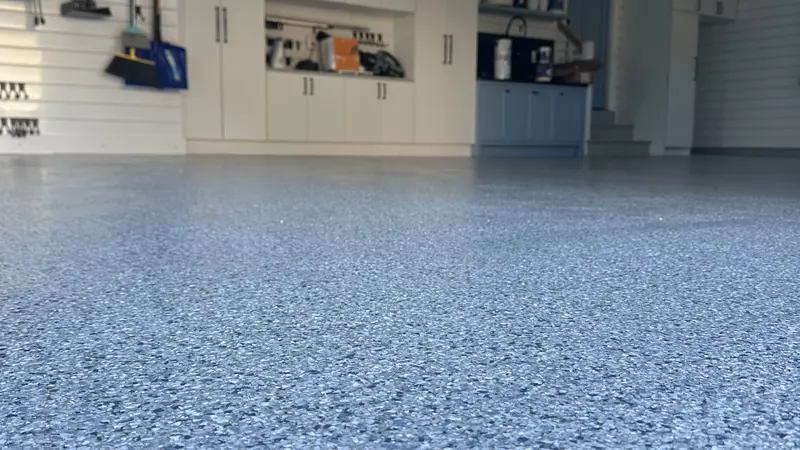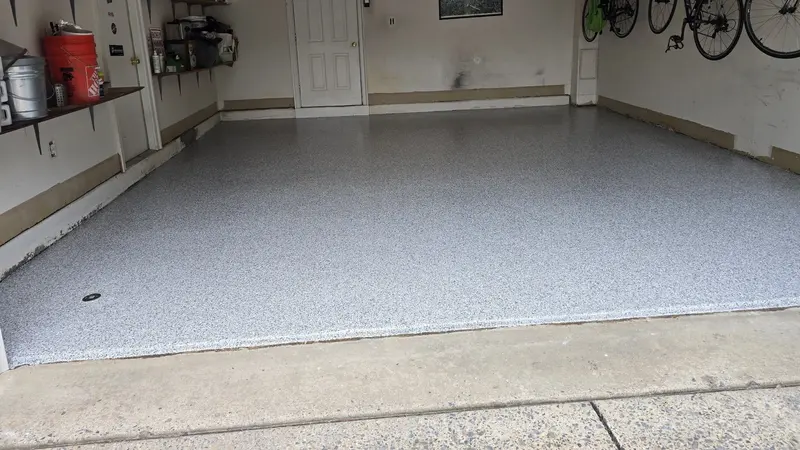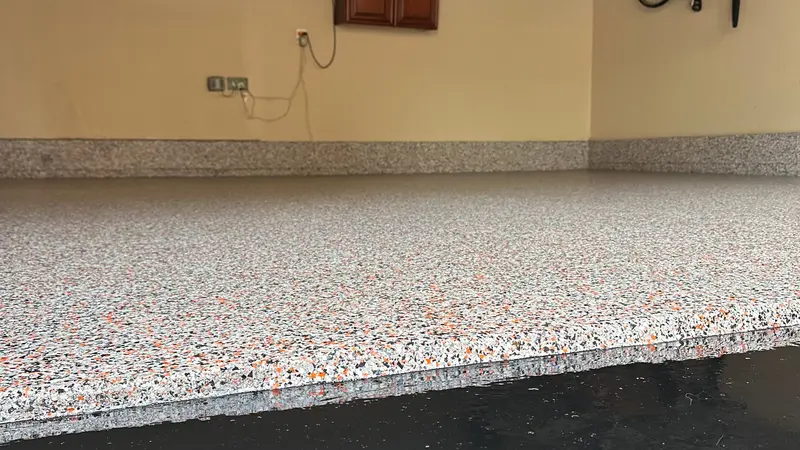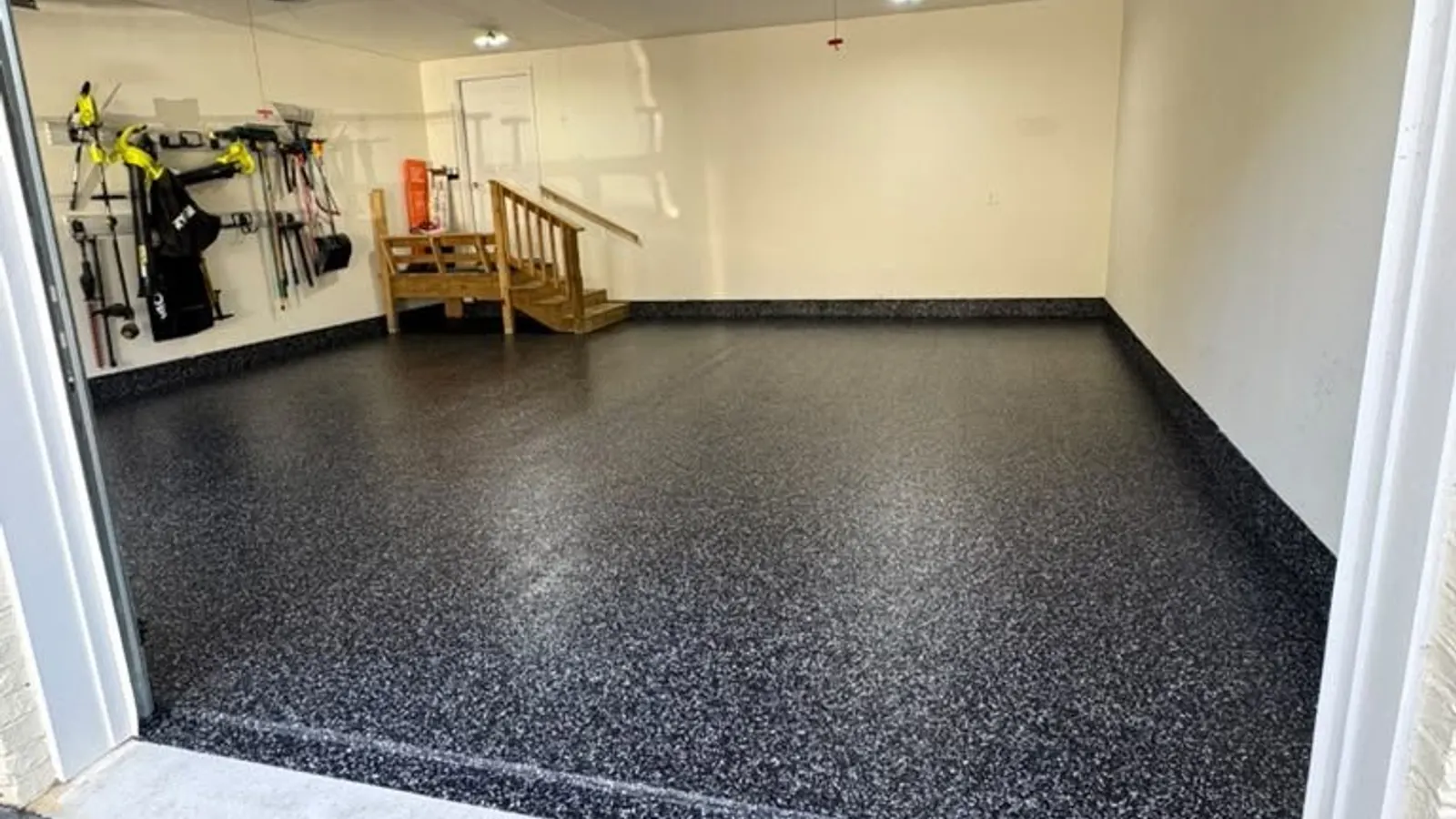
The short answer: epoxy was designed for controlled indoor conditions, and a Northern Virginia garage is not one. Between salted winter tires, August humidity, and afternoon sun hitting the slab through an open door, epoxy tends to yellow, chalk and lift long before homeowners expect it to. Polyaspartic is an industrial coating built for that kind of abuse, which is why most of the floors we install in Loudoun and Fairfax counties now go down as polyaspartic rather than epoxy.
This is not a knock on epoxy as a chemistry. It is a durable, hard film with a long track record on warehouse floors. It just has specific weaknesses, and our climate finds every one of them.
What actually goes wrong with epoxy floors around here?
Three failures show up again and again when we walk into a garage in Ashburn Farm or Cascades and look at a coating that is five or six years old.
The first is yellowing. Standard epoxy is not UV stable. A clean gray or white epoxy floor near a south-facing garage door will shift amber over a few summers, and the line where the sunlight stops is usually visible on the slab. Once it yellows, it stays yellow.
The second is hot tire pickup. Tires get hot on a summer drive up the Greenway. When a warm tire sits on an epoxy film for an hour, it softens the coating and grips it. Back out the next morning and you can pull dime-sized patches of coating up with the tread. That is the classic epoxy failure pattern, and it almost always starts in the two parking footprints.
The third is edge lifting and delamination, and this one is usually about bond, not about the coating itself. A lot of epoxy goes down over concrete that was acid-etched or lightly sanded instead of properly ground. Moisture rising through the slab then pushes at a film that never had a mechanical grip to begin with. It starts at a crack or an expansion joint and spreads outward.
Why does Northern Virginia weather matter so much?
Our slabs live a harder life than most people realize. Loudoun and Fairfax sit on heavy clay soil that holds water. Water under a slab does not stay under a slab. Vapor moves up through concrete constantly, and in July, when the dew point is in the 70s and you open the garage door on a cool slab, you get condensation on the floor itself. A coating that is not fully bonded to sound, profiled concrete has nowhere to go but up.
Winter brings the other half of the problem. VDOT and county crews salt aggressively, and brine sticks to the underside of a car. It drips off in your garage and sits there as a concentrated chloride solution. Bare concrete absorbs it, and when that saltwater freezes inside the pores during a January cold snap, it expands and blows small craters in the surface. That is where most of the pitting we see comes from, not from age.
Polyaspartic resists road salt, oil, brake fluid and the other things that end up on a garage floor, and because it is installed over concrete that has been mechanically ground first, the coating is locked into the profile rather than sitting on top of it. The salt never reaches the slab.
Does the sun through the garage door really make a difference?
It does, and it is the easiest failure to see with your own eyes. Stand in your garage at 4 p.m. in September with the door up and look at how far the sunlight reaches. On a west-facing townhome garage in Brambleton or a detached garage in Great Falls, that can be the first six to eight feet of the floor, every clear afternoon, for years.
Polyaspartic is UV stable. It does not yellow in sunlight, so the floor inside the door looks like the floor by the back wall in year ten. If you are choosing a light gray or a white-heavy blend, that difference is the whole ballgame.
Can polyaspartic go over an existing epoxy floor?
Usually yes, but not by rolling over it. The old coating has to come off. We grind the slab with diamond tooling, which removes the failing epoxy and opens the concrete profile at the same time. Cracks and pitted areas get repaired, then the base coat goes down, flake is broadcast into it, and a clear topcoat locks everything in.
So a failed epoxy floor is not a disqualifier. It is just part of the prep. What matters more is the condition of the concrete underneath, which is one of the things we look at during the free in-home estimate, because it affects the final number.
What about installing in the fall and winter?
This is a practical reason a lot of NoVA homeowners end up on polyaspartic without ever intending to. Epoxy generally needs 50°F or warmer to cure properly, which quietly closes the calendar from roughly November through March in this area, and makes a chilly October morning in Leesburg a coin flip. Polyaspartic can be installed in temperatures down to 30°F.
It also cures fast. Grinding, repair, base coat, flake and topcoat all happen in one day, in an empty garage. You can walk on the floor the same day. Wait 24 hours before you park a vehicle on it. That is the whole timeline, and it is the reason a September or November install is no more complicated than a June one.
What does it cost, and how long does it last?
A one-car garage of about 200 square feet runs $1,500 to $2,000. A two-car garage in the 400 to 500 square foot range runs $3,500 to $4,000. Where you land inside those ranges depends on the condition of your concrete and the finish you pick.
A polyaspartic floor lasts 15 to 20 years or more, and a fresh clear topcoat every 5 to 7 years keeps it looking new. Ours is backed by a lifetime warranty, and we are glad to walk through exactly what that means when we are standing in your garage.
Most people choose a flake blend. The flake adds texture underfoot and does a genuinely good job of hiding dust, tire marks and the gray film that a winter of road salt leaves behind. Creekbed, Tidal Wave and Gravel are the blends we get asked about most. Solid colors, metallics, marbled and quartz finishes are available too. If you have other questions about how the coating behaves day to day, our FAQ page covers a lot of them, and we serve Ashburn, Reston, Vienna, Arlington, Alexandria and the rest of Northern Virginia.
Get a firm price on your floor
We will come out, look at your actual concrete, bring physical color samples, and give you a firm price in about 20 minutes. Call or text 703-936-9006 or request an estimate here. No pressure. No obligation.
Quick answers
The vinyl flake broadcast into the base coat creates a textured surface, so the floor has grip even when snow melts off your tires. It is noticeably less slick than a smooth solid-color coating or sealed bare concrete.
Polyaspartic works on basement slabs, patios and commercial floors as well as garages. The prep is the same: grind the concrete, repair what needs repairing, then base coat, flake and clear topcoat.
The garage has to be completely cleared before we arrive, including shelving, bikes, refrigerators and anything stored along the walls. We will go over exactly what that involves when we give you your estimate.