If your garage floor coating is peeling, curling at the edges or lifting off in sheets when you drag a bin across it, the coating itself is usually not the problem. It is an adhesion problem. Something got between the coating and the concrete, or the concrete was never opened up enough for the coating to grab in the first place. Paint sticks to a surface; a real floor coating has to lock into it, and that only happens when the slab is mechanically prepared before anything is poured out of a bucket.
Here is what causes peeling in Northern Virginia garages, in roughly the order we see it, and what prevents each one.
Cause 1: the concrete was cleaned, not ground
This is the big one. Most failed garage floors we look at in Ashburn, Vienna and Burke were installed over concrete that was degreased, maybe etched with an acid solution out of a jug, and then coated. Acid etching roughens the very top of the surface unevenly and leaves behind salts and residue that have to be rinsed and fully dried. It does not remove the hard, dense layer at the top of a troweled slab, and it does nothing about a builder-applied sealer.
Grinding does. A diamond grinder cuts off the top layer of the slab and leaves a consistent open profile, something like the texture of fine sandpaper. That profile is what the base coat sinks into. Without it, the coating is essentially sitting on top of the floor waiting for a reason to let go, and a hot tire on an August afternoon in Chantilly is an excellent reason.
You can usually tell what happened by looking at a peeled chip. Flip it over. If the back is smooth and shiny and there is no concrete stuck to it, the coating never bonded. If the back has a layer of gray concrete fused to it, the bond held and the concrete itself gave way, which is a different problem and a much rarer one.
Cause 2: moisture pushing up from under the slab
Northern Virginia sits on heavy clay soil that holds water for days after a storm. Garage slabs here are often poured at or near grade, and many older ones were poured without a vapor barrier underneath. Water vapor moves up through concrete constantly. When it hits a coating that will not breathe, pressure builds at the bond line and lifts the coating off in blisters that later break open and peel.
You see this most along the back wall where the slab meets soil on the uphill side, and in garages on sloped lots in places like Great Falls and Lansdowne where water drains toward the foundation. If your floor has a white, chalky bloom on it, that is efflorescence, mineral salts carried up and left behind by evaporating moisture. It is a sign the slab is moving water.
Moisture does not automatically rule out a coating. It does mean the slab needs to be evaluated honestly before anyone quotes a price on it, and it is one of the things we look at during the free in-home estimate rather than guessing at over the phone.
Cause 3: oil, sealer and other things a coating cannot stick to
Concrete is porous. Anything spilled on it for the last fifteen years is still in it. Motor oil, transmission fluid, brake cleaner, spray lubricant, driveway sealer tracked in on shoes, even the wax from a car that was detailed in the garage. Degreasing lifts what is on the surface. It does not pull what has soaked an eighth of an inch down into the pores.
Grinding removes that contaminated layer along with the sealer. Deep oil spots sometimes need additional attention beyond a single pass, which is part of why a real prep step takes time rather than a quick mop and go. This is also why coating over an existing failing coating is a bad idea. You are betting your new floor on the adhesion of the old one, and the old one already told you what it thinks of the concrete.
Cause 4: the wrong product, or the wrong temperature
Big-box epoxy kits are thin, water-based and designed to be installed by someone doing it once. They can look good for a couple of years in a garage that never sees a hot tire. They struggle with hot tire pickup, where a tire that has been running on I-66 in July heats up, softens the coating and pulls it off the slab when the car sits and then backs out.
Temperature matters more than people expect. Epoxy generally needs 50°F or warmer to cure properly. An unheated garage in Leesburg in late October can sit below that for days, and a coating that does not fully cure never reaches its intended hardness or bond strength. Polyaspartic is an industrial coating, the same family of product used in factories, rail cars and stadiums, and it can be installed in temperatures down to 30°F. It is UV stable, so it will not yellow where sun hits the floor inside the door. We go into the differences in more detail in our post on epoxy versus polyaspartic, and on why fall is a good window for this work here.
Can a peeling floor be fixed, or does it all have to come off?
It depends on how much of it failed and why. Take a blunt object and tap around the floor, including areas that still look fine. A bonded coating sounds solid. A debonded one sounds hollow. Run a putty knife under a loose edge and see how far it travels. If it keeps going, the failure is bigger than the visible spot.
Spot repairs over a floor with widespread adhesion failure do not hold. The honest answer for most failed floors is full removal by grinding, back to bare concrete, followed by crack and pitting repair and a proper coating system. That is more work than the original installation was, which is the real cost of skipping prep the first time.
What proper prep looks like
On a Mod Garage install, the floor has to be completely cleared before we arrive, and the day runs in this order:
- Diamond grind the slab to open the concrete profile and remove sealer, old coating and contaminated surface
- Repair cracks and pitting
- Apply the base coat
- Broadcast flake into the wet base coat
- Apply the clear topcoat
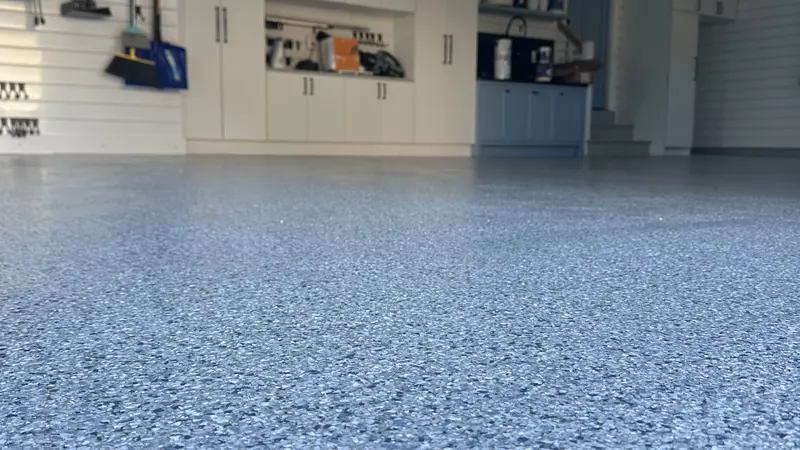
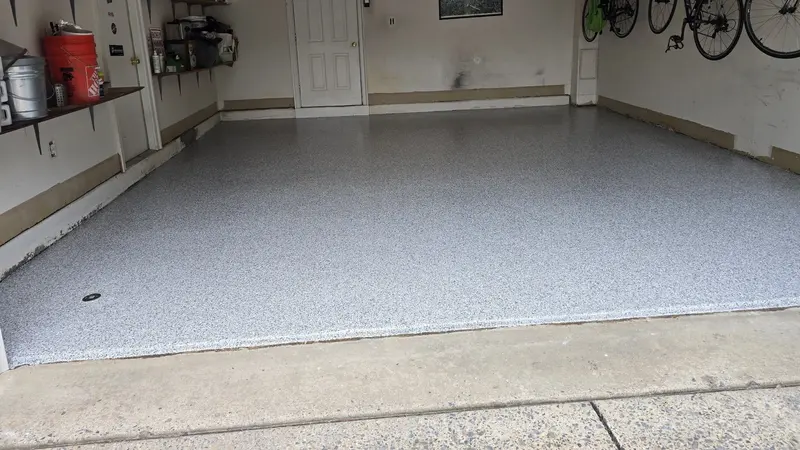
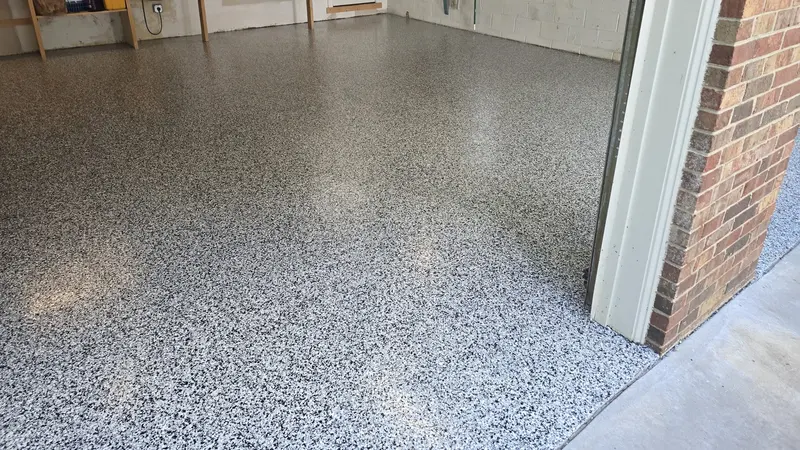
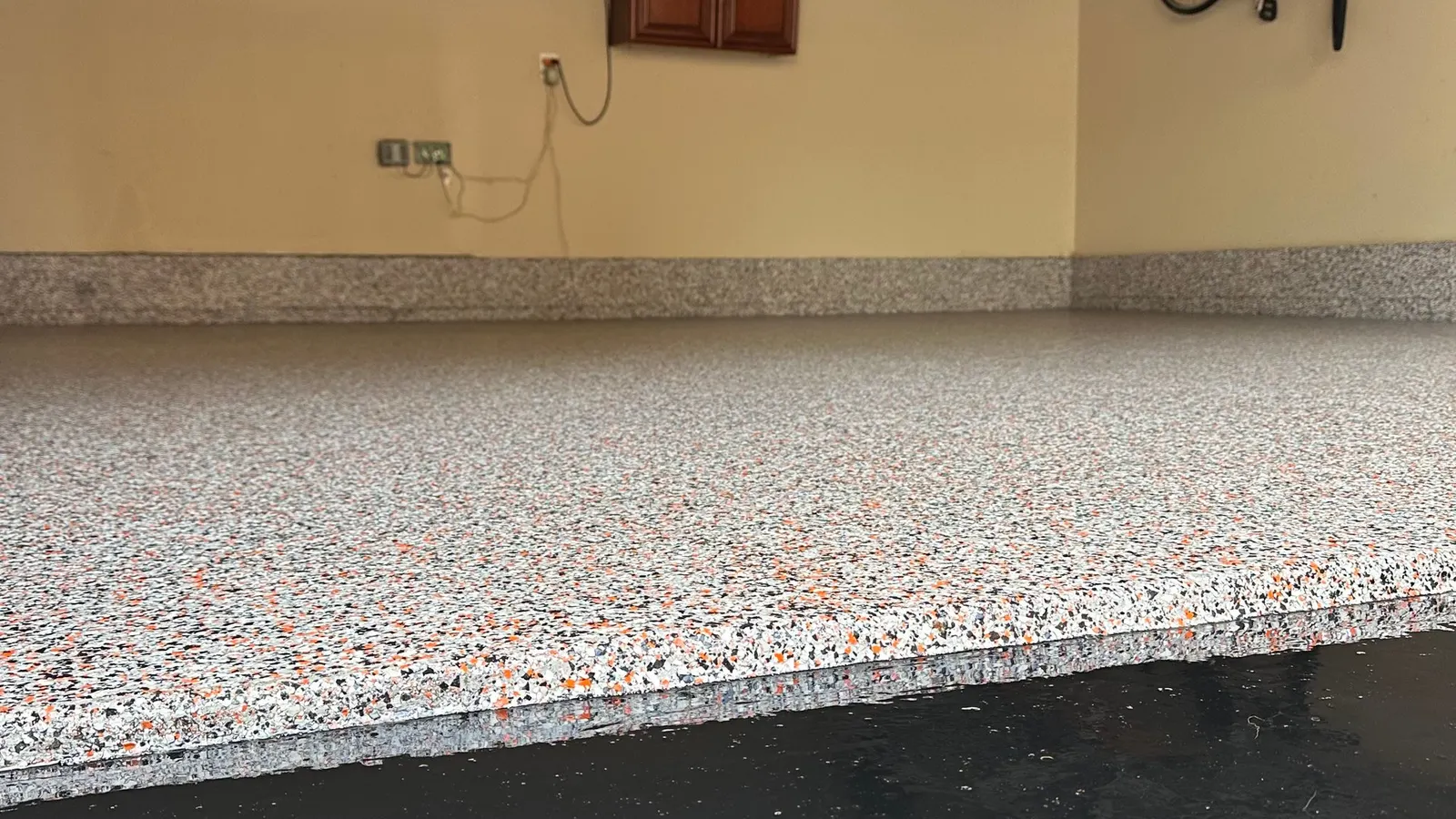
It is a one-day installation. You can walk on the floor the same day, and you park on it after 24 hours. The flake blends, including Creekbed, Tidal Wave and Gravel, add texture underfoot and hide dust between cleanings; you can see the options on our flake color page. A polyaspartic floor installed this way lasts 15 to 20 years or more, a fresh clear topcoat every 5 to 7 years keeps it looking new, and it is backed by a lifetime warranty. If you want the full play-by-play, we wrote a step-by-step walkthrough of installation day.
Get a straight answer about your floor
If your coating is lifting, send us a photo or have us come look at it. The estimate is free, takes about 20 minutes, includes physical color samples, and ends with a firm price. Call or text 703-936-9006 or use the contact form. No pressure. No obligation.
Quick answers
No. A new coating can only bond as well as the layer underneath it, and a peeling coating has already failed at the concrete. The loose material has to be ground off back to bare concrete before anything new goes down.
Pop off a loose chip and look at the back of it. If it is smooth and clean, the concrete was never opened up; if gray concrete is fused to the back, the bond into the slab held. Hollow-sounding spots when you tap the floor are another sign the coating is sitting on top rather than locked in.
Often, yes, because the same prep was used across the entire slab. Tap around the floor and slide a putty knife under the loose edge to see how far the debonded area actually extends before deciding on a repair.